Showing posts with label Garden. Show all posts

09 October 2015

Chicks and Ducklings: Mission Accomplished

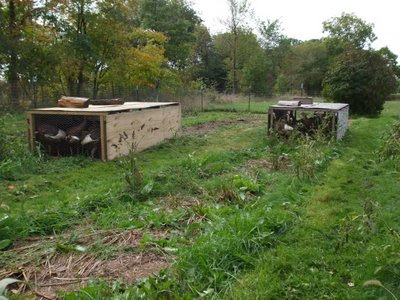
Back in August, we had a couple of fun surprises. First, a mother duck hatched out eleven ducklings. Shortly thereafter, a mother hen hatched out nine chicks. Given the propensity with which baby birds get picked off --- even when being raised by the most-attentive mothers --- we decided to move both broods into a portable 4x8 garden pen. They weren't happy about sharing the space, but it was our only option. They did manage to co-exist, and both broods thrived.

The pen turned out to be a great choice, for several reasons:
  • We were able to get lots of high-protein feed into these little birds. Had they been running around the barnyard, they would've been limited to forage and would not have grown nearly so large nearly so quickly. With autumn approaching fast, we're glad they're in good shape.
  • They cleared out TONS of overgrown weeds from a fallow swath of the garden, that we would otherwise have had to deal with. They got all that green stuff in their diet.
  • They eliminated lots of crickets, beetles, and other bugs from the garden area.
  • They converted all those weeds and bugs into a wonderful layer of rich fertilizer. This portion of the garden will be exploding with growth after next Spring's planting.

Here's a good picture of what they managed to accomplish (in tandem with a second pen, home to nine layer pullets we've been raising since April):

And here's a good shot of what things looked like inside the pen:

With cooler weather and shorter days, we decided it was time to transition the birds and their mothers into the broader flocks. Plus, ducks go through an unbelievable amount of water. I was having to fill their five-gallon waterer at least once per day. (For the nine pullets in the other pen, the interval is more like once per week.) Time for them to go splash around in the swamp with their brethren.

The toughest part was getting the mother hen, and all nine chicks, into the barn last night. We'd turned them loose in the area behind the barn, hoping they'd follow the other birds inside as darkness fell. Unfortunately, they kept trying to get back into the garden; after all, that was the only "home" they remembered, and even Mother Hen had trouble convincing them there was any better place. The two oldest Yeoman Farm Children helped me catch the nine chicks and physically deposit them deep inside the barn. Once Mother Hen joined them, they settled in for the night. They were still piled up in the same nest when I came out this morning.

So far, so good. Next task is to move the Barred Rock pullets. Problem is, they're now so big they're indistinguishable from our two-plus-year-old Barred Rocks which need to be culled. I don't have the time or freezer space to cull them right now, so it's looking like I'll need to put an orange zip tie around a leg on each of the old ones.

Never a dull moment on the farm.

20 October 2011

Our Dog, the Cat

It's been cold, rainy, windy and generally nasty around here for the last several days, which has given very little to smile about. But who can't smile at a dog who's caught more mice in the last week than our barn cats have?

Wilbur has a great nose, and is a great digger. He unearthed and dispatched several moles this summer, and in the last few days has come up with two field mice. Just like a cat, he walks around with the mouse squirming in his mouth. Then he puts it down, watches it flop and stumble around, and plays with it until I approach. Then he picks the squirming, dog-spit-covered rodent back up, retreats a safe distance, and does the whole thing again. Eventually, he finishes the mouse off.

Now, if we could just get him to do his digging somewhere other than Mrs. Yeoman Farmer's garden...

28 September 2011

What Have We Been Doing?

I apologize for the infrequent posting of late. Things have been busy here, but I owe you all an update. There's never a dull moment on a farm.

First off, can you believe this is Post Number Six Hundred? Many thanks to all of you who've been following us and our farming adventures all these years. Sometimes I get the sense that I've said everything that can be said, and that I don't have anything really new to talk about. Do my readers really want yet another post about pastured poultry pens? Or fences the goats have (again) broken through? But as long as you all are game for continuing to hear about our farm, I'll keep writing.

We've had a pretty bad year with turkeys. We started with about 20, and it's looking like we'll harvest no more than seven. Especially given how expensive the baby turkeys are, it's a pretty poor return on investment. We got 15 "surplus" heritage turkeys and 5 giant whites from a mail order hatchery this spring. The "surplus" deal is pretty good, as long as you're not picky; the hatchery sends a variety of heritage breed turkey hatchlings, basically leftovers not needed to fill orders from people who want a specific breed. It's actually a pretty good way to experience several different breeds, and it definitely makes things more fun. We got the giant whites, boring as they are, because it's always nice to have a few really big birds in the freezer.

Anyway, the poults did fairly well in the brooder, but turkeys are notorious for spending the first several weeks of their lives thinking up ways to die.  We moved them out to a pastured poultry pen for several more weeks, and lost a few more. By the time I turned them loose in the fenced goat area by the barn, we were down to five heritage turkeys (all Black Spanish) and four giant whites. I secured them each night in the barn, but a predator still managed to pick off one of the heritage birds. Another of them flew into the kennel and became a chew toy (and meal) for one of our dogs. Then, last week, one of the giant whites developed a serious leg problem; I butchered her on Monday, to make sure we got those 11# of meat before she got any worse.

Here are some of the ones we have left (note the significant size difference between the breeds):
So...are turkeys worth it? We never seem to get a good return on our money, no matter which hatchery we use. But I'll continue raising them, for a couple of reasons. First, there is absolutely nothing like roasting up your own turkey and serving it on Thanksgiving. We've been supplying the turkey for many years now, no matter where we've spent the big day, and it makes the feast special in a way that nothing else can. Even the year we were a thousand miles from home, in the process of adopting Yeoman Farm Baby, we took a turkey with us and the family we shared Thanksgiving with cooked it. Second, a turkey is a great size for serving when we have several visitors (or a large family) over for dinner. With both heritage turkeys and giant whites in the freezer, we can pick just the right size bird for the number of visitors. It's easy to roast, and there's never any shortage of meat.

For day-to-day meals, though, we've found that Cornish Cross broiler chickens are a far more practical size. One of them provides plenty of meat for our family, with some left over for lunches or soup. In the winter, we tend to roast them whole all afternoon in the Crock Pot --- but whenever the weather allows, we prefer to grill them outdoors.

We raised 25 broilers earlier this year, but lost over half of them along the way to predators or other "stupid stuff" like them piling up and suffocating each other during a thunderstorm. We also lost almost all of the replacement egg laying pullets we started at the same time. Faced with an aging and dwindling laying flock, and very few broilers in the freezer, I decided in early August that we should raise another batch before the weather turned cold.

I'm really glad we did. We got 25 more Buff Orpington pullet chicks, and we haven't lost more than one or two. By early next year, our egg production should kick into high gear. Likewise, almost all of the 50 cornish cross broilers have survived, and they're rapidly approaching optimal butchering size. Get a load of the size difference between the two breeds (all the birds in this pen are exactly the same age); this is why it makes so much sense to use Cornish Crosses, and not the males of an egg laying breed, as a primary meat bird:

We've spread the 70-75 surviving birds between three of our movable pastured poultry pens. Each pen is 4'x8', and I'm running all three of them along the edge of our hay field where harvesting hay is difficult. We try to move the pens every day; this supplies fresh greens for the birds' diet (a healthy supplement to the high protein feed which is their main source of calories), gets the birds off their manure, and ensures an even distribution of fertilizer along the field. It's a beautiful system. But here's what it looks like when we don't get around to moving the pen for an extra day:

Toward the right is what the weeds/grass look like after just one day. Toward the left is what happens if something keeps me from getting the pen moved. Note also how we've staggered these two pens as they're moving down the field.

Sometimes, I deliberately keep a pen in one place for extra time, to ensure the birds totally wipe out whatever is growing there. This pen, for example, is down in the impossible-to-cut corner of the hay field, where the grass is so long I can't even get a mower in there. The organic chicken tractor is taking those high weeds down and making sure they doesn't grow back for a long time:

The only problem with having 50 broiler chickens survive is that ... you have to butcher 50 broiler chickens. I try not to do more than five per day, or I tend to go crazy. And since I can't butcher every day, by the time I get to the last broilers they tend to be extremely large. To make sure I don't get too far behind the curve this time, I started butchering a couple of birds this week (along with that turkey with the leg problem), even though they're not optimal size yet.

But you know what? They were still a pretty good size for our family. We got a complete (and absolutely delicious) dinner of grilled chicken out of one of them last night, with a thigh left over for my lunch today. Which I will go in and enjoy momentarily.

But first, lest I leave you with the impression that our whole farm is livestock, I must tip my hat to Mrs. Yeoman Farmer (and the Yeoman Farm Children) for a smashingly successful year of gardening. I tried to capture as much of it as I could with one photo: the 400 row feet of potatoes at the top (which I am going to be enlisted to start digging soon), tomatoes and kale on the right (we cooked up some kale with our chicken last night...amazing), and squashes going a LONG way out of the picture to the far right. On the left is our bee hive, from which I will try to harvest honey this weekend. At the very bottom is a grape vine, clinging to the fence which separates the garden from the hay field (and the deer which run up and down it all year...except during hunting season.) In the background is my office; yes, I get this wonderful view every day as I do my work.

Here's a better shot of the squashes. We're going to be putting up a ton of these "winter keepers" in the pantry:

That's all for now! Thanks again to all who've been following us. I'm looking forward to sharing the next six hundred posts with you!

23 July 2011

Garden Helper

We have a fairly simple division of labor on our farm: I manage the animals, and Mrs Yeoman Farmer manages the plants. MYF is usually very insistent that members of my "team" not intrude on and mess with her garden, and with good reason. Ever seen what happens when a dog discovers how nice it is to dig in freshly-tilled soil? Or when a flock of birds discovers bushes full of beautiful ripe tomatoes? We therefore built a tight fence around the garden, and patrol it diligently.

Then, this morning, MYF observed that our new mother hen was managing to squeeze through a tiny gap near the gate --- and her chicks were easily following her. MYF was about to shoo the hen out, but then she thought more about it. There are no more seeds that could be scratched out or uncovered. There is no fruit yet. The green tomatoes are probably unappealing. The potatoes are safely buried underground. Why not let Henny Penny take her brood on a bug-hunting safari?

So we did. She seems especially interested in the potato portion of the garden, which has lots of little insects hopping all over it.

I'm not sure we want to release the rest of the flock into the garden; some plants would be sure to get trampled. But for now, it's an awful lot of fun watching Henny Penny and her brood do "organic pest control" for us.

04 May 2009

Waterfowl at Work

I recently blogged about how the "chicken tractors" have been helping us get Mrs Yeoman Farmer's garden ready. As the young birds grow older, they seem to eat more weeds and drop more fertilizer by the day. And as I type this, MYF is out in the garden beginning to till some of the garden beds.

The one pen with 15 ducklings and 9 goslings has been particularly productive. As waterfowl are voracious consumers of grass, we thought it made sense to put them in charge of clearing sod from the brand new beds we want to plow up in the lawn.

After just over one week, moving the pen basically once per day, take a look at what they've been able to accomplish:
This is a classic example of sustainable agriculture, and working with nature rather than declaring war on it. And we will enjoy remembering this lesson as we feast on goose all winter long.

19 February 2009

Urban Composting

We do heavy-duty composting here on the farm, what with all the manure and animal bedding we have. Or, to be more precise, we will be doing heavy-duty composting this spring --- once we shovel the whole winter's worth of bedding out of the barn, and I build the composting bin that Mrs Yeoman Farmer has had on my "To Do" list.

But for those of you who are thinking about farming someday, and are trying to start small by acquiring skills right where you are now, composting is an important technique you can begin learning today. The New York Times has details about this new trend:

Composting in New York City is not for the faint of heart. It requires commitment, space and sharing tight quarters with rotting matter and two-inch-long wiggler worms that look like pulsing vermicelli.

But an increasing number of New Yorkers have been taking up the challenge, turning their fruit skins and eggshells into nutritious crumbly soil in an effort they regard as the natural next step to recycling paper, bottles and cans. Food accounts for about 13 percent of the nation’s trash — it is the third largest component after paper and yard trimmings — and about 16 percent of New York’s.

. . .

Happy worms eat about half their body weight in a day, and the compost is ready for harvesting in about four and half months, Ms. Pulverman said.

. . .

Experienced composters said that saving food scraps soon becomes part of a daily routine, and that the payoff is worth the extra work.

“To be actually able to reuse your food is amazing,” said Ben Stein, 30, a computer programmer who, along with his wife, Arin Kramer, 29, a nurse practitioner, composted for six years in their apartment on the Lower East Side before they moved to a brownstone in Brooklyn last year.

In Manhattan, they kept the bin under the bed, which Mr. Stein said led friends to think, “it’s disgusting, and you’re absolutely crazy.” In Boerum Hill, they can compost in their backyard (where microbial activity and decomposition slow down or stop in the winter, but pick up in the spring).


As for us, almost all of our table scraps and vegetable waste are already recycled --- into eggs, via being fed to chickens and ducks. But for those of you lacking poultry...don't be afraid to try feeding the worms!

07 October 2008

Turkeys Hard At Work

I had a couple of posts about turkeys back in the spring, and apologize for not providing some updates since.

Regular readers recall that we're raising Bourbon Red turkeys again this year; they are a wonderful heritage breed, and we've had good luck with them in the past. In getting a garden established on our new property, we decided to incorporate "poultry tractors" into the design from the very beginning. We had a neighbor use his tractor to bust the sod in several four-foot rows across a sunny section of our front yard. Mrs. Yeoman Farmer planted several of these beds this year, and we reserved the remaining rows for our turkeys.

We have 22 mature turkeys now, divided between two portable pens. As described in a post earlier this year, each pen is four feet wide, eight feet long, and two feet high; the eight-foot sections are covered in plywood, and the four-foot sides are enclosed with chicken wire. Every day or two, we've been moving each pen eight feet farther down its own garden bed. In the photograph below, the pens are moving toward the camera. Note the height of the weeds in the portion they haven't gotten to yet, and the complete devastation in the portion behind each pen.


This system has three excellent benefits: the turkeys destroy the weeds, the turkeys get excellent supplemental greens in their diet, and the turkeys provide an excellent layer of fertilizer that can be worked into the garden bed for next year's planting. Next year, we will rotate the pens to the garden beds that were planted this year, and plant our vegetables on the beds the turkeys have been working this year.

Here are the turkeys in one pen, with the lid removed, just before the pen is to be slid down to the next eight-foot patch of weeds. Clearly, they're wondering what's taking me so long.


As for me, I can hardly wait for Thanksgiving.

13 August 2008

Urban Farming, Anyone?

I'm too swamped with work these days to do much but skim headlines, but I couldn't resist clicking through and reading this story. Seems that some foreclosed properties in the City of Detroit are in such bad repair, and owners are so desperate to get them off the books, that houses are actually being let go for just one dollar.

The sale price of the home may be an anomaly, but illustrates both the depths of the foreclosure crisis in Detroit and the rapid scuttling of vacant homes in some of the city's impoverished neighborhoods.

The home, at 8111 Traverse Street, a few blocks from Detroit City Airport, was the nicest house on the block when it sold for $65,000 in November 2006, said neighbor Carl Upshaw. But the home was foreclosed last summer, and it wasn't long until "the vultures closed in," Upshaw said.

"The siding was the first to go. Then they took the fence. Then they broke in and took everything else."

...

Tuesday, the home was wide open. Doors leading into the kitchen and the basement were missing, and the front windows had been smashed. Weeds grew chest-high, and charred remains marked a spot where the garage recently burned.

Put on the market in January for $1,100, the house had no lookers other than the squatters who sometimes stayed there at night. Facing $4,000 in back taxes and a large unpaid water bill, the bank that owned the property lowered the price to $1.

On Tuesday, Realtor.com listed one other single-family home, one duplex and one empty lot at $1 in Detroit.

Dollar property sales are the financial hangover from the foreclosure crisis, said Anthony Viola of Realty Corp. of America in Cleveland.

Lenders that made loans to unqualified buyers during the height of the subprime market now find themselves the owners of whole neighborhoods of vacant, deteriorating homes.

"No one has much sympathy for these banks that made subprime loans," Viola said. "And in some cities like Cleveland, judges aren't letting them sit on the properties -- they're ordering them to tear them down or sell them."

So desperate was the bank owner of 8111 Traverse Street to unload the property that it agreed to pay $2,500 in sales commission and another $1,000 bonus for closing the $1 sale; the bank also will pay $500 of the buyer's closing costs. Throw in back taxes and a water bill, and unloading the house will cost the bank about $10,000.

"It doesn't make sense in some neighborhoods to keep paying costs and costs," Colpaert said. "It can make more financial sense to give it away."


This got me thinking: I wonder if it's possible to acquire one of these urban properties, tear down the house, and somehow use the land for food production? The property must have city water and power. Some remaining portion of the house could be used to store garden tools. I doubt that livestock would be possible, but I bet a person could establish a large market garden and get away with a keeping a pen of laying hens. You could move the pen up and down the unused portions of the garden as a tractor, using the hens to destroy the weeds and return fertility to the soil. (You'd need someplace to move them in the winter time, though.) Chickens are probably technically illegal in the city, but who's going to report you? Hens are quiet, and any nosy neighbors could be bought off with free eggs.


The key, I suppose, would be to put a secure fence around the perimeter. If neighbors have stripped the house of everything valuable, just imagine what they'd do to a market garden.

Anybody know of anyone who's tried doing this kind of thing with an abandoned city property? Could be an interesting way for someone stuck in the city to acquire some gardening skills, and prepare for a move to the country.

10 June 2008

The Rain Keeps Falling

We've been getting an unbelievable amount of rain here, as has much of the middle of the country. As detailed in a recent post, we barely got the first cutting of hay into the barn before the rains started. In the time since, we haven't had another rain-free stretch that would have been long enough to have gotten the hay in. In other words: it's very fortunate we got the hay in when we got it in.

With all the moisture, the hay field has jumped right back into production. According to locals, last summer was so dry, the second cutting yielded only 25 bales (from a six-acre field). This year's second cutting should be a bumper crop.

But the rain also has a downside: Mrs Yeoman Farmer has been unable to plant her garden. We got the sod busted earlier in the spring, and the ground tilled up, but potatoes are the only thing she managed to put in. Those plants are doing great. But all her other seedlings are still sitting in peat pots, waiting to go in the ground.

The NY Times has a story today about the broader effects of all this rain; there are a lot of commercial grain farmers who have been unable to get crops planted. While things could turn around later, the prospects for this year's corn and soybean harvest is looking bleak:

Bob Biehl, whose farm is near St. Louis, has managed to plant only 140 of the 650 acres he wanted to devote to corn. Some farmers in his area “haven’t even been able to take the tractor out of the shed,” he said.

United States soybean plantings are running 16 percent behind last year. Rice is tardy in Arkansas, which produces nearly half the country’s crop. “We’re certainly not going to have as good a crop as we had hoped,” said Harvey Howington of the Arkansas Rice Growers Association. “I don’t think this is good news for anybody.”

Harvests ebb and flow, of course. But with supplies of most of the key commodities at their lowest levels in decades, there is little room for error this year. American farmers are among the world’s top producers, supplying 60 percent of the corn that moves across international borders in a typical year, as well as a third of the soybeans, a quarter of the wheat and a tenth of the rice.

“If we have bad crops, it’s going to be a wild ride,” said the Agriculture Department’s chief economist, Joseph Glauber. “There’s just no cushion.”


No cushion. That, it seems to me, is one of the biggest problems with ethanol subsidies and mandates --- and the wildlife conservation programs that pay farmers to take land out of production. They may seem like good ideas when harvests are bountiful, but it's hard to tell when a year like this current one may be coming. And by the time we're in the midst of a year like this one, it's far too late to reverse course.

Few of us can do anything about soaring gas prices; backyard oil wells are impractical, and backyard oil refineries are even less so. But food is different: nearly everyone with a bit of sunny yard can plant a garden. My hope is that this year of soaring food prices will lead more Americans to rediscover gardening and other ways of producing their own food.

Assuming, of course, that the rain ever lets up enough for even us backyard gardeners to get our plots planted...

28 May 2007

Farming for the Future

There is a really outstanding video out about a movement of small-scale farmers in Southeast Ohio, called "Farming for the Future". Beautiful visuals, and excellent commentary from the farmers themselves about why they're doing this and what it all means. Very thought-provoking, and inspiring. You can watch the streaming video here.

These folks are actually making money at organic farming, and it appears to be their full-time occupation, which puts them several steps beyond us. Our own focus is still on producing wholesome food for our family; we only sell excess production to others. But we do know folks who are able to do this kind of thing more or less full time, and this video gives a great view of that.

Some of the farmers give eloquent descriptions of their philosophical motivations and objections to conventional (chemical-based) farming; one in particular describes the "warfare technology" most farmers employ---which I think is an apt characterization. The video also does an excellent job of showing the connection between these farmers and the community (particularly at the farmers market). One thing that's missing, though, is a sense of family involvement and how this style of farming provides harmony not only with nature but with the proper ordering of family life. They do show some husbands and wives farming together, but children are conspicuously absent. But that's a minor quibble.

Thanks to Athos for alerting me to the video.

19 May 2007

Death Row

The garden is now largely planted, but there has been a problem: one chicken in particular has repeatedly managed to find a way in and tear up the tender young seedlings. We tried chasing her out, but she's been extremely resourceful in getting back in. Most mornings when I wake up, she's already out there poking around.

Around here, that earns a chicken a one-way ticket to Death Row. Particularly since this one is a meat breed that I simply didn't get butchered last year (and her useless eggs are the size of marbles), her time is up. This old dog cage is where our fowl spend their last hours; the metal cone is what we use for actually butchering them. The bird goes upside down into that cone, then I slit the throat and let the bird bleed to death (kosher style). This method is very effective at bleeding the bird thoroughly, and is much less messy than the "cut the head off with an axe and watch it run around the barnyard" method.

My wife also suspects our three Guinea fowl have been tearing up the garden, and I was preparing to butcher them today as well. But she, acting as Governor, decided to give them a last minute stay of execution. We strongly suspect that this one chicken has been responsible for the bulk of the damage, and she's willing to spare the Guineas for a few days. If the garden remains unmolested, the Guineas live. If not...I'm getting out my .22 rifle and going hunting. (Guineas fly so well, and roost so high in the barn, they're nearly impossible to catch.) I really like the Guineas a lot, so I hope they behave themselves. They're wonderful bug-catchers, and with Japanese Beetle season (and the seventeen year locusts) just over a month away, I'd like to have all hands on deck. Stay tuned.